
Every chore has one clear owner
Assign chores to one child, a group, or the whole family. Each chore carries its own coin value, due date, and an optional repeat schedule — daily, weekly, monthly, or custom.
Family Chores turns household jobs into a clear, motivating system: one owner per chore, coins and rewards kids care about, parent approval only where you want it, and Responsibility XP that turns every completed job into measurable life-skill growth.
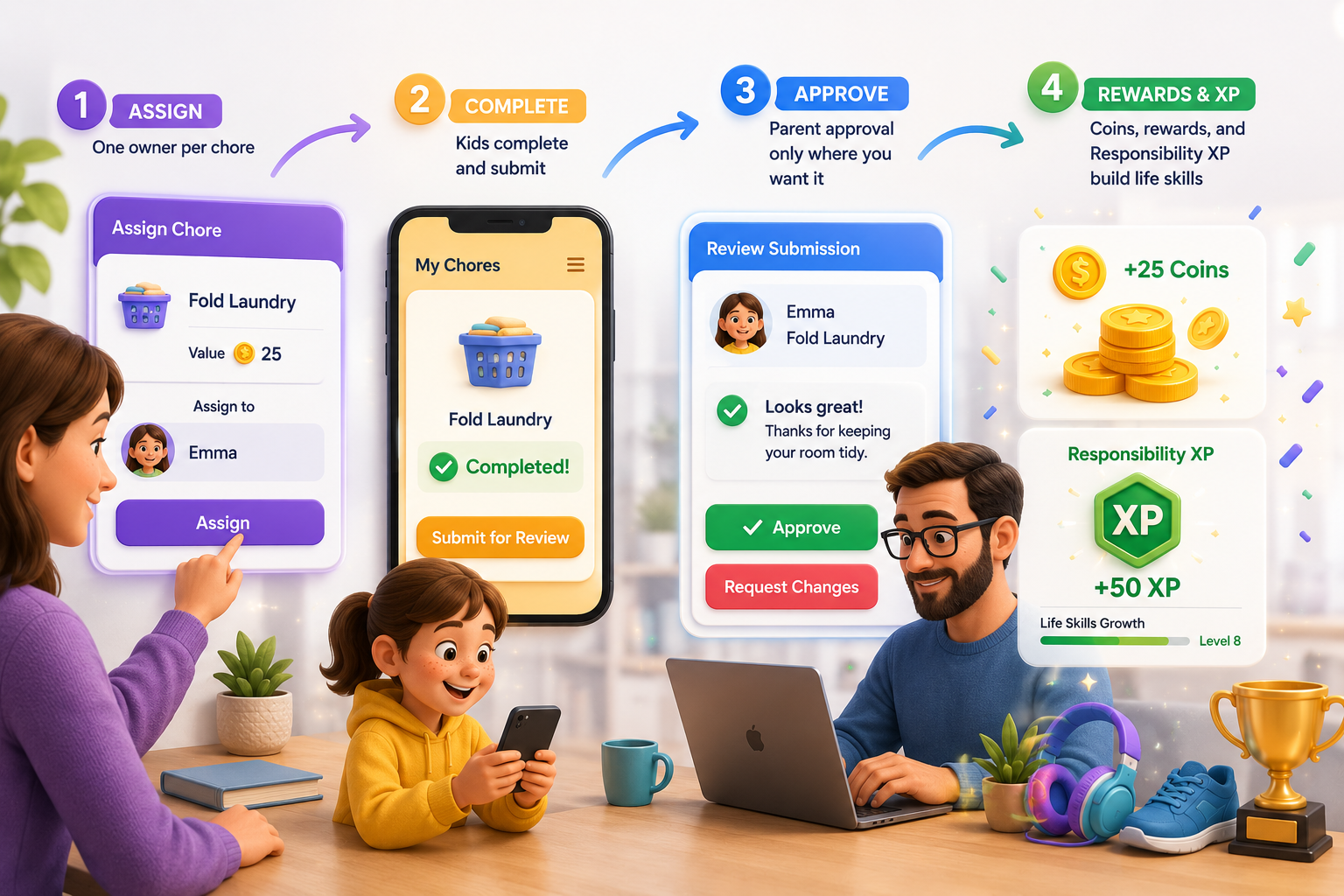
Four steps, repeated until they become habits. Parents set the rules once; the system carries them every day after that.
Assign chores to one child, a group, or the whole family. Each chore carries its own coin value, due date, and an optional repeat schedule — daily, weekly, monthly, or custom.
Children check off chores from their own dashboard, a shared-tablet Kiosk Mode, or right after school. Coins pay out instantly for trusted chores.
Flag any chore as approval-required and it waits for a parent's sign-off before coins move. Adjust the payout at approval time if the job was half done — or above and beyond.
Tag chores with a Responsibility Pillar and every completion earns Responsibility XP alongside coins — visible progress toward real life skills, not just a cleared list.
There's no universal chore quota. These are the principles that keep a chart fair as your child grows — start where they are, and let the work scale with them.
A good first chore is one your child can finish without you hovering. Short, visible jobs — making a bed, feeding a pet, clearing their plate — build the habit of finishing before you add harder work.
When a chore stops needing reminders, it's ready to level up. Move from helper tasks to owning a full job with a quality standard, then to running a whole domain like laundry or cooking by the teen years.
Whatever you pay, keep it proportional to effort. Family Chores lets you set a coin value per chore and adjust it at approval time, so a half-done job and an above-and-beyond one don't earn the same.
The hardest part of any chore chart is remembering it. Group related chores into a routine with its own schedule, and the structure does the reminding instead of you.
Six age-by-age guides, each with 28–31 specific chores tagged by the Responsibility Pillar it develops, time estimates, and what families on the platform actually assign most.
28 age-appropriate chores - most assigned: Make the bed
Ages 7–828 age-appropriate chores - most assigned: Make the bed neatly
Ages 9–1030 age-appropriate chores - most assigned: Unload and reload the dishwasher
Ages 11–1230 age-appropriate chores - most assigned: Do a full load of laundry start to finish
Ages 13–1430 age-appropriate chores - most assigned: Do your own laundry completely
Ages 15–1631 age-appropriate chores - most assigned: Plan and cook two family dinners a week
Most chore charts die in a fortnight. These are the mechanics that keep this one alive.
The first time a child ever completes a chore, Family Chores pays an automatic +5 coin New Skill Bonus and +10 Responsibility XP. Trying new things is rewarded by design — it's how chore lists turn into skill lists.
Coins buy avatar gear, themes, quest content, and custom family awards that parents define — movie night, a sleepover, a later bedtime. The reward is whatever actually motivates your child.
Completions, approvals, and milestones appear in a realtime family activity feed, so effort gets noticed the moment it happens — no end-of-week accounting required.
Ready for the next level? Group chores into reusable routines that build Pillars of Responsibility.
Short answers here — the age guides go deeper on every range.
Five and six year olds do best with short, visible helper jobs like making the bed or feeding a pet. By 9–10 kids can own full jobs with quality standards, and teens can run whole domains like laundry, cooking, and car care. Our age guides list 28–31 specific chores per age range, each tagged with the life skill it builds.
Families differ, and Family Chores supports both styles. Coins can pay out for every chore, only for above-and-beyond work, or be set to zero with rewards tied to routines and milestones instead. A common approach is to pay a little more as the work gets harder — you set the coin value per chore, so the choice stays yours.
Three things consistently help: a visible list kids check themselves, rewards that pay out without a parent remembering, and routines that bundle chores into one repeatable habit. When the structure does the reminding, you don't have to.
Decades of research link childhood chores with adult success, work ethic, and wellbeing. Chores teach competence, contribution, and follow-through — which is why Family Chores maps every chore to one of five Responsibility Pillars and tracks that growth over time.
Set up chores with coins, approvals, and repeat schedules once — then watch completions, rewards, and Responsibility XP take over the daily follow-up.
Sign in with Google, add your kids as managed profiles, and assign your first chore in under five minutes.